
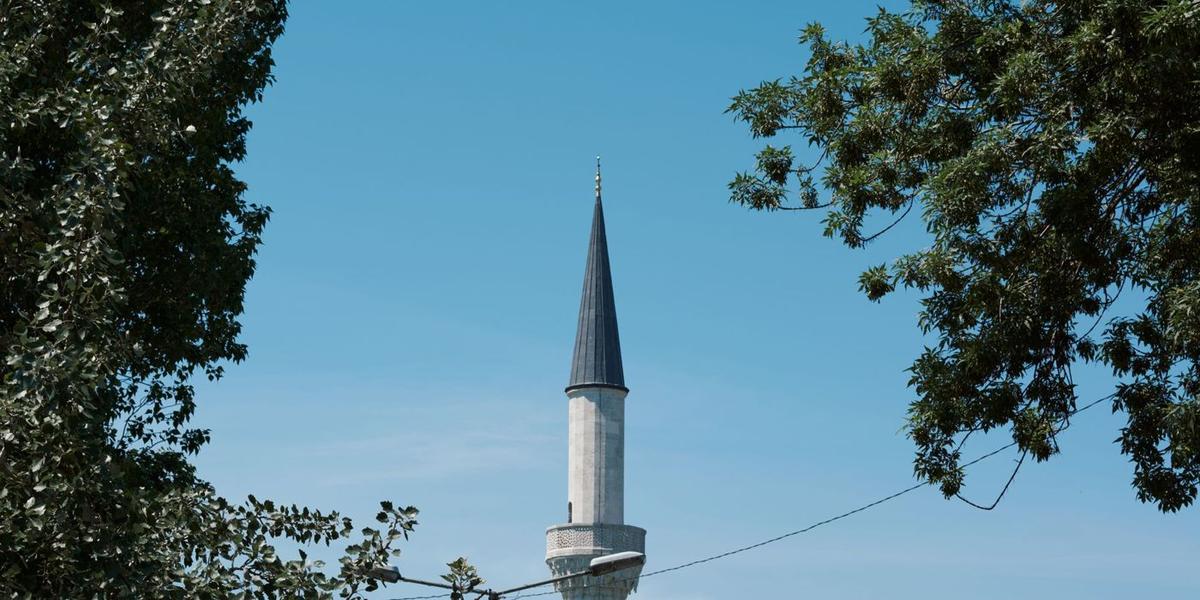
Allahu Akbar means Allah is greater, often heard in English as “God is the greatest.” The act of saying it is called the takbir. Muslims use it in prayer and in strong everyday moments. For the wider habit of Arabic phrases in English speech, see why Muslims use Arabic expressions.
What does Allahu Akbar mean?
Wikipedia’s Takbir article glosses Allāhu akbar as “God is the greatest [of everything].” Wiktionary’s English entry says “God is most great.” The Arabic Wiktionary line is simply “God is greater.”
Some writers prefer “God is greater” as short for “greater than all.” Either gloss points at the same affirmation: nothing outranks Allah.
How is it written and pronounced?
Arabic:
ٱللَّهُ أَكْبَرُ
Latin forms you will see: Allahu Akbar, Allahu akbar, AllahuAkbar. Spoken guide: al · laa · hu · ak · bar. Enough for chat and captions; not a Qur’an recitation class.
When do Muslims say Allahu Akbar?
In prayer. The phrase marks stages of salah. Sahih al-Bukhari 735 describes raising the hands when opening the prayer and saying the Takbir for bowing. The call to prayer (adhan) also carries the wording, as Wikipedia notes.
In post-prayer remembrance. Sahih al-Bukhari 843 places Allahu Akbar with SubhanAllah and Alhamdulillah in a set of thirty-three repetitions after the fard prayers (companions debated how the total count was divided).
Outside the prayer row. Wikipedia lists informal uses in joy, distress, or determination. Someone may say it when something feels overwhelming, not only when standing on a prayer mat.
Seeing something vast:
Allahu Akbar. That view is unreal.
Hearing heavy news and turning to God:
Allahu Akbar. May Allah make it easy.
Sample lines for speech context only. This page is not a salah how-to.
How do you respond when you hear Allahu Akbar?
Unlike Assalamu Alaikum, the takbir has no required return phrase. When the feeling is shared, quietly saying it with them can fit:
Allahu Akbar.
A plain English nod also works if you are not joining the Arabic wording:
That’s overwhelming.
If you hear the phrase in a news clip or a heated online argument, do not assume the everyday religious meaning without context. This page explains the speech and worship sense; it does not settle every political or media use.
Allahu Akbar compared with other expressions
- SubhanAllah: exaltation and wonder (“glory be to Allah”).
- Alhamdulillah: praise and gratitude.
- Mashallah: admiration of a good already in view.
- Astaghfirullah: asking Allah for forgiveness.
- Ameen: closing a request to Allah.
Allahu Akbar magnifies. It declares greatness. Quran 29:45 says the remembrance of Allah is greater; that supports the theme without replacing the exact takbir wording.
Common questions
Is “God is greater” or “God is the greatest” correct?
Both appear in careful English writing. Wiktionary and Wikipedia use “most great” / “greatest”; some authors stress the comparative “greater.” This page treats them as the same affirmation.
Why do I only hear it in headlines?
Because some media and political contexts amplify the phrase. The religious meaning in prayer and everyday Muslim speech is older and broader. We are not using this page to invent a ruling about every slogan or clip.