
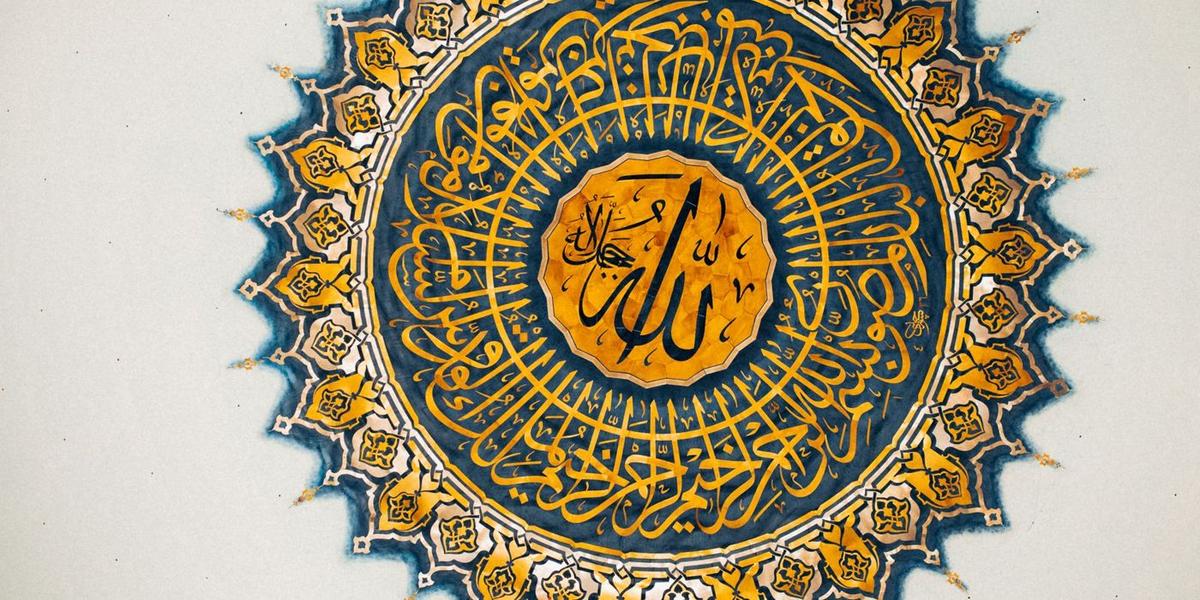
Bismillah is the phrase Muslims say before they begin something. It means in the name of Allah. Because it opens so many small moments, from a first bite to a long journey, it is one of the first Arabic phrases an English speaker notices. For the wider habit behind phrases like this, see why Muslims keep Arabic in everyday speech.
What does Bismillah mean?
Bismillah is short for the full formula, Bismillah ir-Rahman ir-Rahim, which Wikipedia renders as In the name of God, the Most Gracious, the Most Merciful. The short version keeps only the opening words, in the name of Allah.
The full phrase carries four parts: bi (with, by), ism (name), Allah, and then two names of mercy, al-Rahman and al-Rahim. Wikipedia notes the phrase is traditionally called the Tasmiya, and the name Basmala comes from the first four consonants of the Arabic wording.
Wiktionary lists Bismillah as an interjection meaning, in the name of Allah. It is not a request you make of another person and not a statement about the world; it is a way of starting an act by naming God.
How is it written and pronounced?
Arabic: بِسْمِ ٱللَّٰهِ ٱلرَّحْمَٰنِ ٱلرَّحِيمِ
Transliteration: bismillāhi r-raḥmāni r-raḥīm.
English spellings vary a great deal: Bismillah, Bismillah ir-Rahman ir-Rahim, Bismillahir Rahmanir Rahim, and Basmala. Each version names the same Arabic phrase, which is why they stay together on a single page.
Approximate pronunciation: bis · mil · laa · hir · rah · maa · nir · ra · heem. The dotted letters mark sounds English does not use, so treat this as a rough cue and learn the exact sounds from a teacher if you plan to recite.
When do Muslims say it?
The pattern is simple: before an action. Four common cases come up again and again.
Before eating or drinking. A well-known narration in Sahih al-Bukhari has the Prophet telling a boy to mention the Name of Allah, eat with his right hand, and eat from what is nearest to him. So the phrase opens a meal.
Bismillah.
Before wudu (ablution). Sunan Abi Dawud reports that ablution without mentioning Allah’s name at the start is not valid. The exact weight of that ruling is a legal question, and this page does not settle it; the report is why many Muslims say Bismillah before wudu.
Before a journey or a task. In Quran 11:41, Noah tells those with him to embark in the name of Allah. Muslims who start a drive, a flight, or a piece of work often echo that pattern.
Bismillah. Let's start.
Bismillah. Here we go.
Before a private act. Sahih al-Bukhari 141 records the phrase said before sexual relations, with a supplication asking for protection. It shows the phrase is not confined to public or polite settings.
What if you forget to say it before eating?
Both Sunan Abi Dawud 3767 and Jami’ at-Tirmidhi 1858 give the same remedy. If the beginning was missed, say the phrase that covers the beginning and the end of the meal.
Bismillahi awwalahu wa akhirahu.
That asks for Allah’s name over the meal, from its start through to its finish. Tirmidhi gives the wording in transliteration as Bismillah Fi Awwalihi Wa Akhirih. The narration offers a way to catch up, rather than carry on as if the meal had no beginning.
Where does Bismillah appear in the Quran?
It opens Al-Fatihah as the first verse (Quran 1:1), which is where most people meet it in recitation.
It also appears inside the text of a surah, at Quran 27:30, where it introduces the letter from Solomon to the Queen of Sheba. Wikipedia notes it is recited before each surah except the ninth, At-Tawbah, and that the 1924 Cairo Edition counts it as the first verse of Al-Fatihah while leaving it unnumbered elsewhere.
Bismillah and Bismillah ir-Rahman ir-Rahim
The short and long forms are the same phrase at different lengths. Bismillah says only, in the name of Allah. Adding ir-Rahman ir-Rahim names two of Allah’s attributes of mercy, the Most Gracious and the Most Merciful, which is why the long form is the one written at the head of a page or spoken at the start of a formal act.
If you want the other common expressions from this site in one place, Assalamu Alaikum is the greeting, Ameen seals a dua, SubhanAllah marks wonder, and Alhamdulillah is the phrase of praise.
Common questions
Is Bismillah the same as a dua?
Not exactly. A dua is a request or a call. Bismillah is a phrase of dedication spoken over whatever you are about to do, so people often describe it as asking for blessing in the act, but its words are a statement of whose name the act begins in.
Do you say it out loud?
Practice varies. Some say it quietly and some say it aloud, and the sources here do not fix a volume. Follow the people you are with.
Is Bismillah only for Arabic speakers?
No. Muslims who do not speak Arabic use it as a fixed phrase before eating and before other actions. The meaning travels even when the language does not.
Why do the English spellings differ?
All four spellings describe the same Arabic words. English writes those sounds differently from one writer to the next, so any of these versions should lead you to the same phrase.
Everything above rests on the listed sources, and where they stop short of a ruling, so does this page. See the sources policy for how we choose evidence.